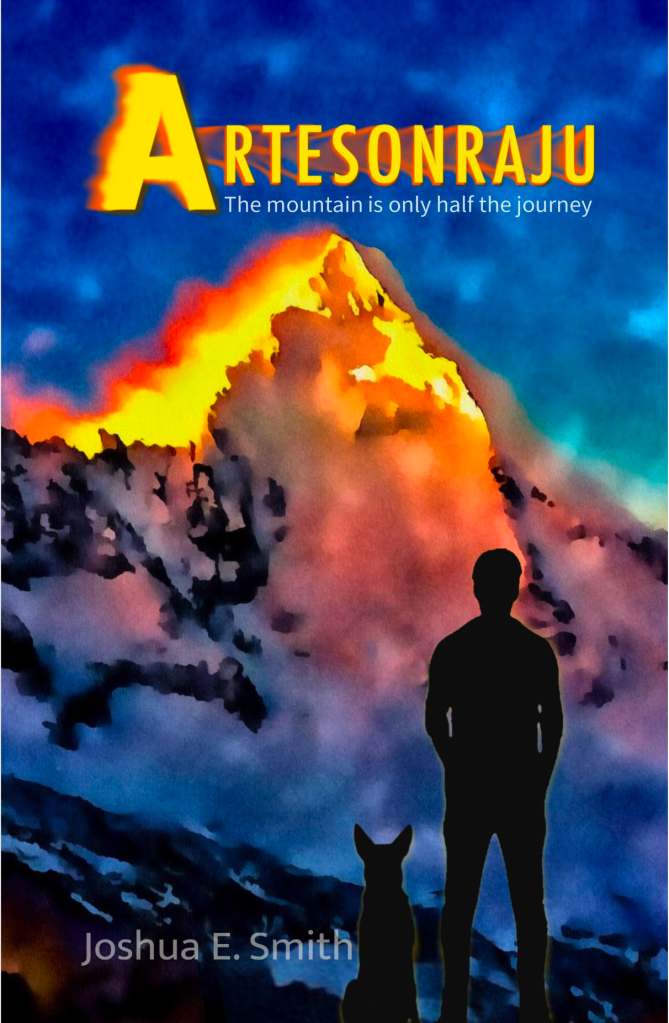
In Artesonraju, the narrator, Josh, and his climbing partner, Adam, travel from the United States to South America to attempt to climb Artesonraju, one of the most beautiful peaks in the Peruvian Andes. On their first foray into the mountains, Josh gets dangerously sick from the altitude, and he and Adam must retreat to civilization to regroup.
In their subsequent attempts to get back in the mountains and salvage their trip, they encounter bandits who want a horse in exchange for safe passage, share a taxi with a kidnapped puppy, ride the most dilapidated roller coaster in the hemisphere, and eventually climb a mountain.
The unfamiliar environment of Peru often stymies and challenges Josh. As he and Adam navigate setbacks, he learns important things about himself and begins to discover that Adam has much greater intellectual and spiritual depth than he had suspected. Artesonraju will appeal to all lovers of travel and adventure writing.
______________
Prologue
Stars seen from 16,000 feet are numerous beyond reason, and their piercingly bright light is barely diluted by the thin veil of nitrogen and oxygen separating the hard ground of the high mountains from the even harder vacuum of space. Stripped of the softening filter of the atmosphere, they lose the familiar hazy twinkle of a summer night sky and become sharp and unblinking.
I grew up under country skies in North Carolina, away from night-poisoning street lights. I usually felt a comfortable companionship with the celestial diorama as seen from fields and hills, but the distribution I now saw above me was starkly new. The unsettling intensity of the starlight and the unfamiliar constellations of the southern hemisphere magnified my feelings of unreality. The only southern constellation I could name was the Southern Cross, so I scanned the sky for it and unexpectedly spotted Orion, bigger and brighter than he’d ever been. “What’s he doing down here?” My mind was churning feverishly, and I wondered if I might be hallucinating. But real or imagined, he provided a small touchstone of familiarity on the terrible walk I was taking through the dark Peruvian night.
My stumbling reverie was interrupted by a desperate imperative. “Down, down,” I said, and the stars spun and vanished as I dropped to my knees and then fell on my face in the dirt. Adam stopped, saying nothing, even when I struggled to my knees and began heaving dryly. Eventually,
my ragged breathing calmed. The bitterly cold air of high altitude began to penetrate my clothing, and I tried ineffectually to stand before shivering set in. Adam grabbed the back of my jacket and hauled me upright. The motion seemed almost aggressive, and I wondered if he was angry at me for putting us both in this situation. Still, his hand on my back was a comfort and steadied me on the vertiginous trail that unfolded before us one step at a time in the dim yellow pool of our headlamps.
Time and distance are funny. Logically, they should be absolute, not the subjective beasts they so often are. At home, warm, hydrated, and dressed in shorts and running shoes, one mile along a trail is negligible, to be covered in thoughtless comfort in minutes. When roped up a rock or ice face, time dilates, and even a few hundred yards can stretch into hours. On that mountain trail, in the darkness, distance and time expanded into new realms. The irregular cadence of my staggering steps had the feel of eternity. I took a step, then another, and had to stop because the
trail trended up a rise, and I was only fit to descend. “Oh boy, oh boy, oh boy,” I said. Adam’s grip tightened. I said again, “Down, down, down,” and fell forward.
Ahead, in half a mile or so, was a stone monument with a small engraved plaque commemorating the death from altitude sickness of a 15-year-old boy a few years prior. On the hike up earlier that day, we noticed the plaque with sober and reverential curiosity. Altitude is a weird and subtle hazard, often striking without regard to fitness or previous acclimation, causing the brain to swell or the lungs to fill with fluid. It kills infrequently but can come on quickly and hard, and being fifteen is no grant of immunity. Altitude alone had claimed that boy, and I was saddled with the added complications of dysentery and a fractured immune system. My choices had narrowed: continue downwards towards a margin of safety or give up and lie on the frozen ground. Overhead, I could see those disconcerting southern stars, large and crisp. “Up,” I said, and Adam’s strong arm once again pulled me erect and stabilized me as he gripped the back of my jacket. Like some strange, drunken four-legged beast, we lurched down the trail towards the shrine, towards thicker air, towards the future, but oh-so-slowly. I wondered if the night would ever end–or worse–if it would never end.
Available on Amazon
 Joshua E. Smith, Author